
Understanding OAP Core Clinical Services Funding

Navigating autism funding in Ontario can feel overwhelming.
Families often have questions about how the Ontario Autism Program, also known as the OAP, works, what Core Clinical Services funding can be used for, how funding amounts are determined, what happens during the Determination of Needs meeting, and what options families have if they disagree with the outcome.
This post provides an overview of OAP Core Clinical Services funding and what families may want to know as they move through the process.
Please note: OAP information can change. Families should always confirm current details directly through AccessOAP or the Government of Ontario before making funding decisions.
What Is the Ontario Autism Program?
The Ontario Autism Program is a provincial program that provides services and supports for children and youth with a diagnosis of autism spectrum disorder who live in Ontario.
The OAP includes several service pathways and supports. One of these pathways is called Core Clinical Services.
Core Clinical Services funding is intended to help families purchase eligible clinical services and supports based on their child’s needs.
These services may include supports such as:
Behavioural services, including ABA
Speech-language pathology
Occupational therapy
Mental health services
Eligible technology, program materials, or therapy equipment when recommended by a qualified professional
For many families, Core Clinical Services funding is one of the most important funding pathways because it can be used to purchase individualized services from qualified professionals.
How Do Families Access Core Clinical Services?
Families do not automatically receive Core Clinical Services funding as soon as they register for the OAP.
Children and youth are invited into Core Clinical Services based on the date they registered with the Ontario Autism Program. When a family is invited, they will be contacted and asked to complete steps through AccessOAP.
AccessOAP is the independent intake organization for the Ontario Autism Program. AccessOAP helps families register for the OAP, navigate available services, complete the Determination of Needs process, and receive their funding allocation.
The general process looks like this:

What Is the Determination of Needs Meeting?
The Determination of Needs meeting is sometimes called the DON meeting.
This meeting is completed with an AccessOAP care coordinator. The purpose is to better understand your child’s strengths, needs, support requirements, and priority goals.
The DON meeting is not the same thing as a clinical assessment completed by your ABA provider, speech-language pathologist, occupational therapist, psychologist, or other clinician. The DON process helps determine your child’s OAP funding allocation. Clinical assessment and treatment planning happen separately with the professionals you choose to work with.
During the DON meeting, the care coordinator will ask questions across several areas of your child’s development and daily life.
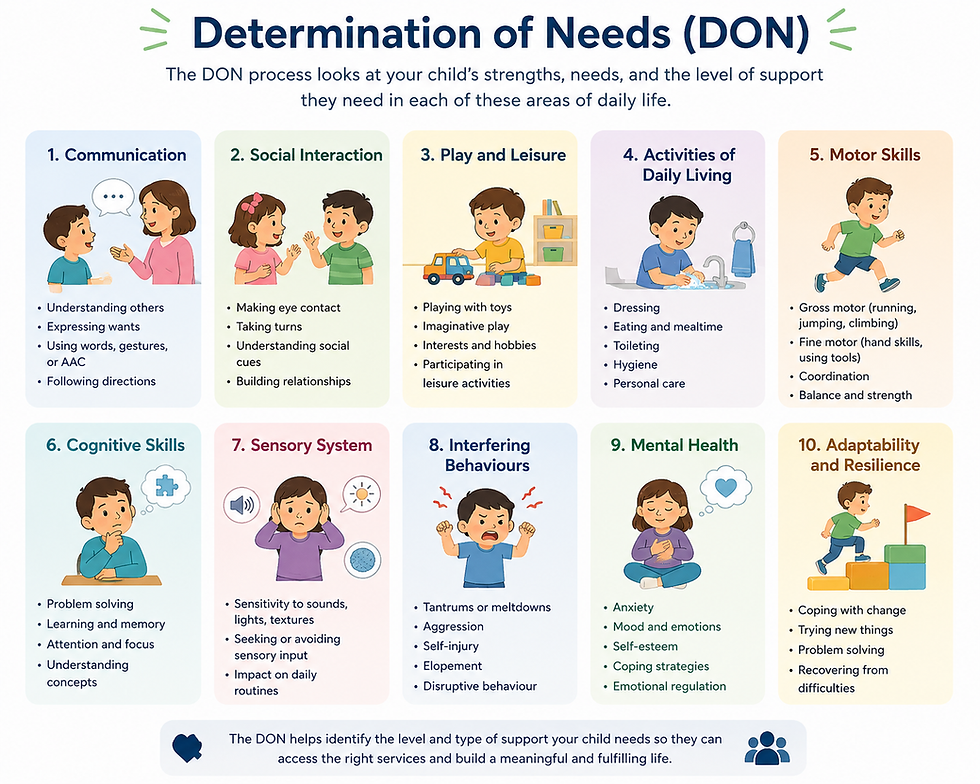
Care coordinators may also consider other factors, such as your child’s developmental stage, life stage, co-existing health needs, and environmental factors.
The goal is to understand how much support your child needs across daily life, not just whether they have a diagnosis.
How to Prepare for the DON Meeting
The DON meeting can feel stressful because the outcome is connected to your child’s funding amount. Preparing ahead of time can help you feel more organized and confident.
Before the meeting, it can be helpful to think about your child’s needs across everyday routines, not just during their best moments.
Try to prepare examples related to:
Morning routines
Meals and snacks
Dressing and hygiene
Toileting
Sleep
Transitions
Communication
Safety awareness
Community outings
School or daycare participation
Play and leisure
Emotional regulation
Sensory needs
Social interaction
Challenging or unsafe behaviour
Independence
Support needed from adults throughout the day
When preparing, ask yourself:
What can my child do independently?
What can my child do with reminders or support?
What does my child need full assistance with?
What happens when support is not available?
What situations are unsafe?
What routines are most stressful for our family?
What skills would make daily life easier or safer?
What support does my child need at home, school, childcare, and in the community?
Are there needs that may not be obvious to someone who only meets my child briefly?
It can also help to write down specific examples.
For example, instead of saying:
“My child has difficulty with transitions.”
You might say:
“My child needs adult support for most transitions. When we move from preferred activities to non-preferred activities, they may drop to the floor, run away, scream, or refuse to move. We use warnings, visuals, choices, and support, but transitions are still one of the hardest parts of our day.”
Instead of saying:
“My child needs help with safety.”
You might say:
“My child has limited danger awareness and requires close adult supervision in parking lots, near roads, and during community outings. They may run without warning and do not consistently respond to stop instructions.”
The goal is to clearly explain what support your child actually needs.
Documents to Gather Before the DON Meeting
If available, families may want to gather:
Autism diagnostic report
Previous or current ABA reports
Speech-language pathology reports
Occupational therapy reports
Psychological or developmental assessments
School reports
Individual Education Plan, also known as an IEP
Behaviour plans or safety plans
Incident reports, if relevant
Medical letters or documentation
Mental health documentation, if relevant
Notes from current service providers
Examples of communication systems, visuals, or supports your child uses
A written list of your child’s strengths, needs, and priority goals
You may not need every document, and not every family will have all of these reports. Bring what you have and focus on the information that best explains your child’s current support needs.
Questions to Ask During the DON Meeting
Families can ask questions during the DON process.
You may want to ask:
Can you explain how this process works?
What information is being used to determine my child’s level of support needs?
Are the needs I described being captured in the correct areas?
Can I provide examples from home, school, or the community?
Can I submit additional documentation?
When will we receive the funding allocation?
What happens after we receive the funding allocation?
Who do I contact if I believe something important was missed?
What is the process if I disagree with the outcome?
Take detailed notes during the meeting or use a tool to transcribe the meeting word for word. This may be handy in case an apeal is needed.
Funding Amounts for Core Clinical Services
OAP Core Clinical Services funding is based on both age and level of support need.
The funding amount is determined through the Determination of Needs process. Families do not choose the amount, and service providers do not determine the amount.
Current commonly reported annual funding ranges are depicted in the image below.

For some age groups, there are different levels of support need, such as limited, moderate, moderate plus, or extensive. The specific amount a family receives depends on the outcome of the Determination of Needs process.
This means two children the same age may receive different funding amounts depending on their assessed support needs.
It also means that funding may change over time as a child’s age, developmental needs, support needs, and circumstances change.
Because funding amounts and program rules can change, families should confirm the current funding table directly through AccessOAP or the Government of Ontario.
What Can Core Clinical Services Funding Be Used For?
All services at Progressive Steps Training & Consultation in can be purchased using Core Clinincal Services Funding. Families can also use this funding to purchase eligible services and supports from other qualified providers.
This may include services such as:
ABA therapy (Offered at Progressive Steps)
Behaviour consultation (Offered at Progressive Steps
Speech-language therapy
Occupational therapy
Mental health services
Clinical assessments related to eligible services
Treatment planning
Caregiver training related to eligible clinical goals
Certain therapy materials, equipment, or technology when recommended by a qualified professional
Families should carefully review the current OAP guidelines before purchasing services or materials. Not every service, item, program, or expense is eligible.
When in doubt, families should contact AccessOAP or review the official OAP guidelines before using funding.
Choosing a Provider After You Receive Funding
Once your family receives a Core Clinical Services funding allocation, you can choose eligible providers who meet OAP qualification requirements.
This is an important step. Funding can help families access services, but families still need to choose providers carefully. The right provider should not only meet the basic funding requirements they should also be a good fit for your child’s needs, your family’s priorities, and the type of support you are looking for.
When speaking with potential providers, families may want to ask about:
Staff qualifications and clinical supervision
Experience with your child’s age, needs, and goals
How therapy goals are selected
How progress is measured and shared
How parents and caregivers are involved
How concerns are addressed
How the team responds when a child is upset, avoidant, or overwhelmed
Whether the provider’s approach aligns with your family’s values
Whether fees, policies, scheduling, and expectations are clear
Core Clinical Services funding can support access to therapy, but the quality and fit of the provider still matter.
For a more detailed guide on this topic, you can read our related post: Questions to Ask When Choosing an ABA Provider
What If I Disagree With the Funding Amount?
Some families may feel that the funding allocation does not reflect their child’s actual support needs.
Families often refer to this as an appeal, but it is important to know that AccessOAP’s public information describes a concerns, complaints, disputes, and review process.
If you disagree with the outcome or believe important information was missed or misunderstood during the Determination of Needs process, you can contact AccessOAP to raise your concerns.
AccessOAP’s Independent Review Office is responsible for dealing with complaints and disputes about AccessOAP services. This may include concerns related to the process used to determine a child or youth’s level of support needs.
Families may want to:
Ask for clarification about how the decision was made
Review whether all relevant information was considered
Provide additional documentation, if appropriate
Clearly explain what information you believe was missing or misunderstood
Submit a formal concern or complaint through AccessOAP’s process
It is helpful to keep records of communication, dates, documents submitted, and the specific concerns you raised.
Tips for Writing a Strong Concern or Review Request
If you are submitting a concern about the Determination of Needs process, try to be clear, specific, and organized.
You may want to include:
Your child’s name and OAP information
The date of the DON meeting
The funding amount received
The areas of need you believe were not fully captured
Specific examples of your child’s support needs
Any safety concerns
Reports or documents that support your concerns
A clear request for review or clarification
For example, instead of saying:
“My child needs more help than this.”
You might say:
“We are concerned that the funding allocation does not reflect the level of adult support required for safety during daily routines. Our child requires close supervision during transitions, community outings, and self-care routines due to elopement risk and limited safety awareness. We are requesting a review of whether these needs were fully captured during the Determination of Needs process.”
Clear examples are often more helpful than general statements.
Common Questions Families Have
Is the DON meeting the same as an ABA assessment?
No. The DON meeting is used to determine OAP funding. An ABA assessment is completed by your chosen clinical provider to understand your child’s learning needs, behavioural needs, goals, and treatment recommendations.
Does my service provider decide my funding amount?
No. The funding amount is determined through the OAP Determination of Needs process, completed through AccessOAP.
Can I choose my own ABA provider?
Yes. Families can choose qualified providers who meet OAP requirements. Families are not limited to one agency or one type of provider.
Can funding be used for group programs?
It depends on the program, provider qualifications, treatment goals, and whether the service meets OAP eligibility requirements. Families should confirm eligibility before using funding for a specific group program. All groups offered by Progressive Steps are can be purchased with OPA funding.
Does higher funding always mean more ABA hours?
Not necessarily. Core Clinical Services funding may be used across different eligible services, such as ABA, speech-language therapy, occupational therapy, mental health services, and eligible materials or equipment. Families may need to prioritize services based on their child’s needs.
Can funding change each year?
Yes. The Determination of Needs process is completed at least annually for families enrolled in Core Clinical Services so funding can reflect changing support needs.
References and Helpful Links
AccessOAP Family Portal FAQ — AccessOAP explains that families are invited into Core Clinical Services based on OAP registration date, and that care coordinators guide families through the Determination of Needs process at least annually.
AccessOAP Determination of Needs information — AccessOAP describes the DON as a standardized process covering ten domains: communication, social interaction, play/leisure, activities of daily living, motor skills, cognitive skills, sensory system, interfering behaviours, mental health, and adaptability/resilience.
AccessOAP Concerns and Complaints / Independent Review Office — AccessOAP says its IRO handles complaints and disputes about AccessOAP services, including issues related to the processes for determining support needs.
Government of Ontario: Ontario Autism Program Core Clinical Services — Ontario’s page explains that after accepting an invitation, an AccessOAP care coordinator guides families through the process to determine support needs and funding for Core Clinical Services.
Government of Ontario: Guidelines for Core Clinical Services and Supports — Ontario’s guideline page explains the objectives and eligible services for Core Clinical Services.
Government of Ontario: OAP Provider List / Information for Practitioners — Ontario explains that the OAP Provider List is a directory of clinicians who meet required qualifications to provide autism services through the OAP.
Final Thoughts
OAP Core Clinical Services funding can be an important support for families seeking autism services in Ontario. However, the process can feel confusing, especially when families are waiting for an invitation, preparing for a Determination of Needs meeting, trying to understand funding amounts, or deciding what to do if they disagree with the outcome.
The most important things to remember are:
Registering for the OAP is the first step.
Core Clinical Services funding is accessed by invitation.
The Determination of Needs meeting helps determine the funding amount.
Funding amounts are based on age and assessed support needs.
Families can choose qualified providers.
The DON meeting is separate from clinical assessment and treatment planning.
Families can raise concerns if they believe the process did not accurately capture their child’s needs.
At Progressive Steps, we know that funding decisions can have a major impact on a family’s ability to access services. We encourage families to ask questions, prepare for funding meetings, review official OAP information carefully, and choose providers who align with their child’s needs and family values.


Comments